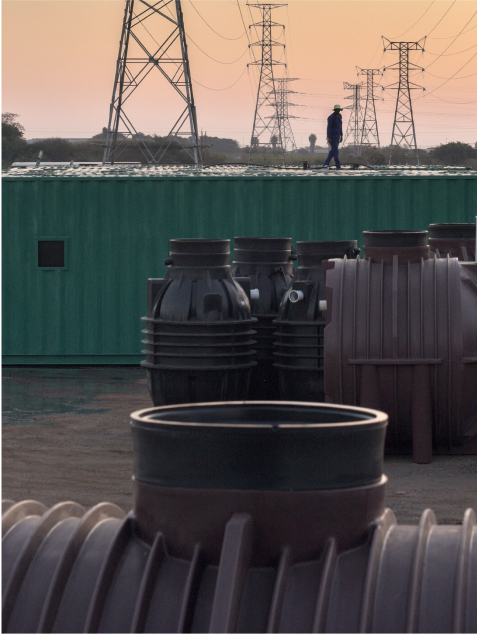

Since 2007, Calcamite Water & Sanitation Solutions has been at the forefront of manufacturing small-scale decentralised wastewater treatment plants (DEWATS) across South Africa and the broader African continent. To date, approximately 2000 systems have been installed, collectively treating an estimated 2.2 million m³ of wastewater per year; turning a challenge into an asset for communities, businesses and remote sites.
What Makes Decentralised Treatment Sustainable?
The sustainability impact of small-scale decentralised wastewater treatment is multi-dimensional and benefits the environment, communities and local economies.
Environmental Benefits
1. Reduced Carbon Footprint
Unlike large, centralised sewer systems that depend on extensive reticulation networks, small decentralised plants treat wastewater close to the source. This significantly reduces energy use and greenhouse gas emissions associated with long-distance pumping infrastructure.
2. Water Conservation & Reuse
Properly treated effluent meets regulatory quality standards and can be safely reused for irrigation, dust suppression and toilet flushing, reducing pressure on freshwater resources.
3. Groundwater Recharge & Pollution Prevention
On-site treatment helps maintain a healthy local water balance. By preventing untreated sewage from entering soil and waterways, these systems protect ecosystems and human health. Biological processes during treatment break down organic matter without the use of harmful chemicals, ensuring cleaner discharge.
4. Nutrient Recovery
Nutrients like nitrogen and phosphates, which would otherwise contribute to pollution, can instead support irrigation and soil enrichment when responsibly managed.
Social & Economic Benefits
1. Greater Accessibility
Small-scale plants have lower capital and operational costs than large municipal systems, making wastewater treatment financially accessible to households, schools, clinics, lodges, and rural businesses that lack sewer connections.
2. Community Resilience
Decentralised treatment creates a distributed network of systems. A single unit’s failure doesn’t disrupt an entire community’s sanitation infrastructure, which improves resilience and reliability.
3. Local Employment
Routine maintenance, monitoring, and support services create local jobs, build skills, and strengthen community capacity.
Challenges and Operational Considerations
No system is without trade-offs. The very strength of decentralisation, having many small plants instead of one big one, also introduces management complexity. Monitoring thousands of units scattered over large geographical areas is more challenging than supervising a single, centralised plant. If maintenance is neglected, poorly performing units could collectively degrade environmental quality before issues are detected.
While Calcamite’s plants are designed to be robust and relatively low maintenance, regular checks remain critical to ensure that:
- flows stay within design capacity,
- mechanical and electrical components function correctly,
- there are no leaks or blockages.
Proper operation and maintenance help ensure effluent quality meets the requirements under the National Water Act and related standards.
Making Decentralised Management Smarter
To address the complexity of distributed wastewater systems, Calcamite has begun piloting remote monitoring and control technology in collaboration with 4Sight, a South African automation specialist.
Intelligent Monitoring with AVEVA + Schneider Electric
The pilot plant, designed for 15 m³ of wastewater treatment capacity per day, deployed a remote monitoring and control system built on the AVEVA platform, a globally recognised industrial software suite, with on-site control via a Schneider Electric PLC that connects to the cloud.
This setup allows operators to remotely monitor key operational parameters, including inflow and outflow volumes, sludge return rates, electrical data, and aeration system pressures. These are critical to the bioreactor’s health and overall treatment performance.
The Benefits
- Professional off-site oversight: Qualified process controllers can now adjust operations based on real-time data, improving effluent quality and reliability.
- Preventative maintenance: Early warnings and trend analysis help prevent failures before they occur.
- Cost savings: With fewer site visits required, maintenance becomes significantly more cost-effective, a major advantage for remote locations.
These technologies, scaled appropriately and cost-effectively, expand the viability of decentralised systems for individuals, small institutions, rural clinics and schools, and they’re helping to bridge the gap where centralised sewer connections do not exist.
Looking Ahead: AI and Smarter Design
The integration of artificial intelligence (AI) into monitoring and analytics opens further opportunities:
- identifying patterns to optimise future plant designs,
- evaluating flow and treatment performance across multiple facilities,
- and providing early alerts for potential plumbing or system failures.
By combining innovative technology with sustainable infrastructure, small-scale decentralised wastewater treatment plants are not just treating wastewater, they’re helping build a more resilient, equitable and water-secure future.
Alternative version
Sustainability Impact of Small-Scale Decentralised Wastewater Treatment Plants
Calcamite Water & Sanitation Solutions has been manufacturing small-scale decentralised wastewater treatment plants since 2007. Today, approximately 1 800 systems are installed across South Africa and the rest of Africa, with a combined treatment capacity of about 2.2 million m³ per annum.
The sustainability impact of small-scale decentralised wastewater treatment plants is multi-dimensional. Environmentally, these systems reduce the carbon footprint by eliminating the need for extensive sewage reticulation networks. They support a local water balance by enabling groundwater recharge and preventing pollution and toxic discharge through biological treatment processes. Treated water can be safely reused for irrigation, dust suppression, and toilet flushing, while nutrients such as phosphates and nitrogen are recovered and applied for irrigation.
From a social and economic perspective, decentralised wastewater treatment becomes more financially accessible because these plants require lower capital and operational investment. The approach is also more resilient, as the failure of a single plant does not disrupt an entire community. In addition, decentralised systems generate local employment opportunities through ongoing operation and maintenance.
Despite these sustainability benefits, challenges remain, particularly in terms of management complexity. Monitoring thousands of small plants is far more demanding than managing a single large facility. If maintenance is neglected, numerous small units may begin leaking pollutants, resulting in cumulative environmental damage that is difficult to detect and control.
Although the plants are not onerous to maintain, it is essential to ensure that flows remain within the design capacity, mechanical equipment operates correctly, and no leaks occur within the system.
Calcamite has recently implemented a pilot plant using a remote monitoring and control system designed by 4Sight, a South African automation specialist. The solution incorporates the AVEVA platform, a global industrial software system used to design, operate and optimise physical assets and plants. The plant control system is enabled by a Schneider Electric PLC, which connects directly to the AVEVA cloud platform.
The AVEVA platform presents a significant opportunity to make decentralised plant management more viable. It is well-suited to small, modular treatment systems, provided the automation, monitoring and control technologies are appropriately scaled and remain cost-effective. This ensures financial accessibility for private users, institutions, schools and clinics in rural and remote locations.
The first Calcamite wastewater treatment pilot project deployed on the AVEVA platform is located in a remote area without access to a central sewer network. The plant is designed to treat 15 m³ of wastewater per day and is situated in a nature reserve where the treated discharge is reused for irrigation. The platform enables remote monitoring of inflow, outflow, and sludge return volumes, as well as electrical parameters and aeration system pressures, which are critical for the bioreactor where most biological treatment processes occur.
Remote monitoring allows off-site professional process controllers to oversee the plant daily. They can adjust sludge return volumes during off-peak periods to improve treatment efficiency and implement preventative maintenance based on key performance parameters. Maintenance can now be carried out more cost-effectively, as fewer physical site visits are required, improving overall financial viability for clients.
The application of artificial intelligence in this context is particularly promising. AI can help define appropriate design parameters for future plants, analyse flow and treatment efficiencies across existing systems, and provide early warnings of leaks or failures in building plumbing and treatment infrastructure.