
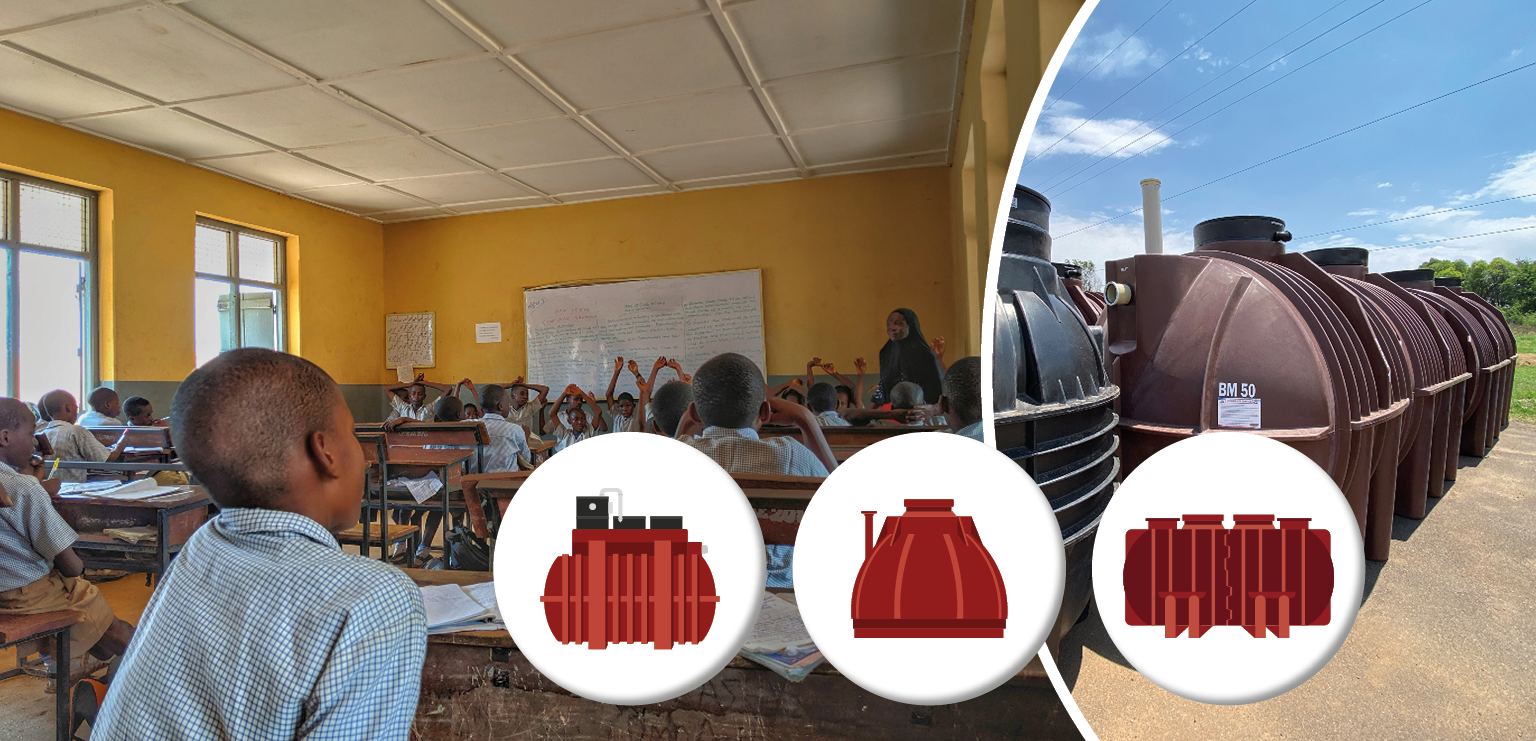
Schools often need to take on more learners, putting tremendous strain on sanitation systems unable to cope with the increased load. Unless addressed as a matter of urgency, pollution spreads in an environment where sanitation safety is critical.
What are the options when schools need to increase sanitation capacity?
Conservancy tanks
A conservancy tank is a watertight tank that contains sewage but does not treat it. It means that the sewage must be removed by a honeysucker or desludge truck and be treated elsewhere.
The practicality of this approach depends on the amount of sewage generated, the availability of a licensed desludge truck, and the distance from a suitable sewage treatment plant.
In the below case study, a school’s learner number increased from 600 to 1 000 pupils. The sewage flow increased from 24m³/day to 60m³/day. The current sewage system has a holding capacity of 72m³.
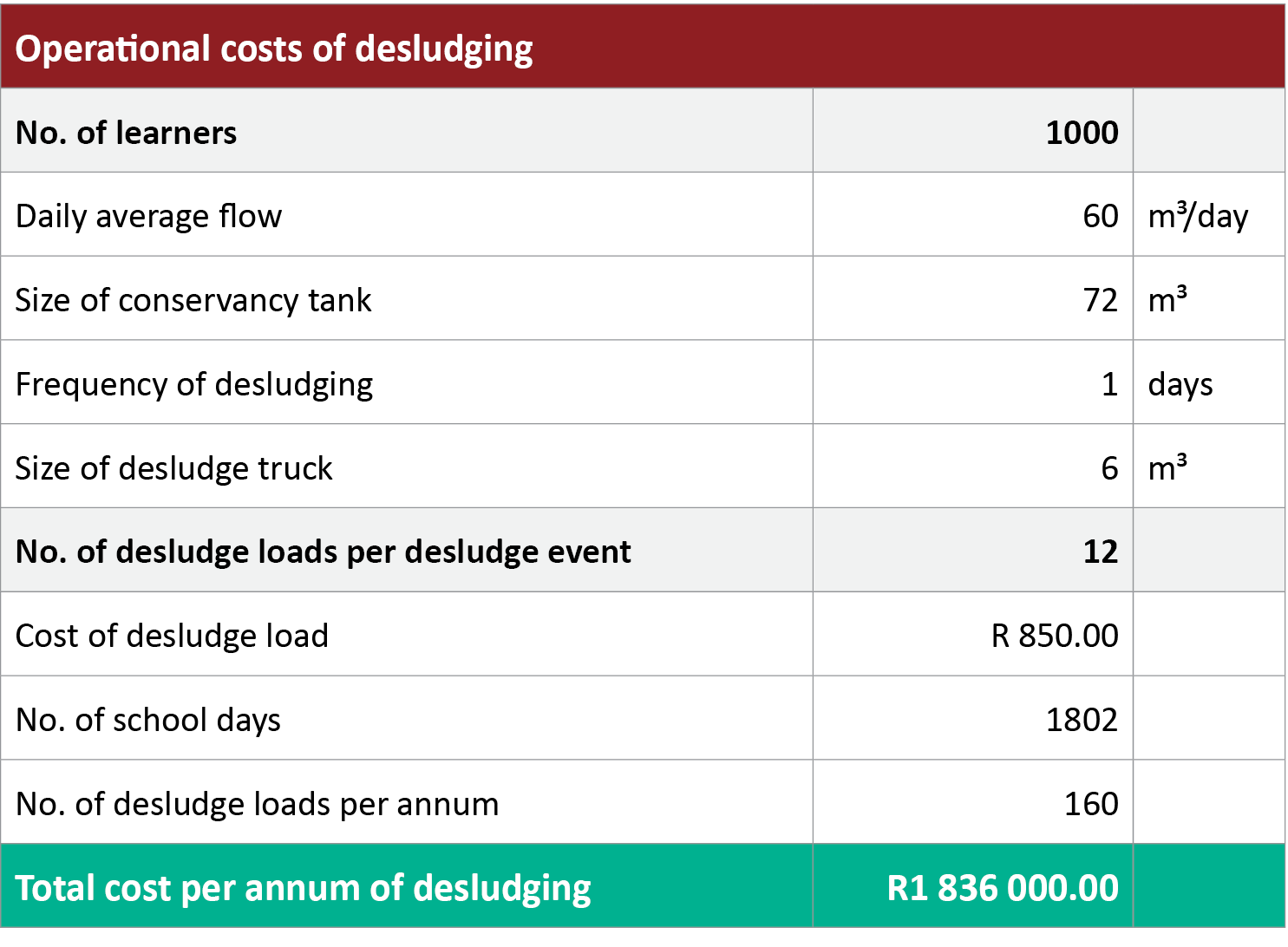
In the above scenario, it is doubtful that the desludge truck will be able to keep up with the daily flow, which will cause the conservancy tank to eventually overflow and lead to a raw sewage spill.
The norm is to have 2-3 days of storage in a conservancy tank. In other words, the capacity of the conservancy tank will need to be doubled to provide for situations where there is no desludge truck available.
The capital cost required for the supply and installation of an additional 80m³ conservancy tank is about R600 000, depending on location and ground conditions.
Septic tank with a soakaway
A septic tank with a soakaway is an alternative on-site wastewater treatment solution.
There are several disadvantages to septic tanks, including poor pathogen removal and odours. It is also not possible to construct soakaways if the soil percolation rate is not adequate. Furthermore, the soakaway needs to be an appropriate size and must be relocated every 5 years, or whenever it becomes saturated.
The capital cost of installing a septic tank is similar to that of a conservancy tank, but the soakaway needs to be added. The appropriate size is very important for successful operation.
Assuming a soil percolation rate of 300lt/m²/day, and a flow of 60m³ per day, the required size of the soakaway is 200m². The required depth is at least 1m below ground level and 30m away from any boreholes and buildings.
The soakaway must be filled with course gravel or appropriate proprietary soakaway products. The cost is about R1 million-R1.3 million for such a major construction project. If the price of an additional septic tank to ensure a 48-hour retention time and manage peak flows is included, the cost amounts to R1.6-R1.9 million.
On a practical level, few schools have the space to relocate a soakaway. Percolation rate also decreases in the rainy season, causing uncontrolled effluent run-off and pollution over a larger area.
To put this into context, a tennis court-sized piece of land is effectively destroyed every decade. This land is often more valuable for school expansion than for sewage disposal.
Small on-site wastewater treatment plant
The third alternative is to upgrade the existing septic tank with additional capacity to manage peak flows and add septic and bioreactor capacity to treat the water to irrigation standards. This means the water can be safely reused to irrigate sport fields, suppress dust build-up, or for a garden, since the wastewater treatment plant removes harmful pathogens.
Treating water to Department of Water and Sanitation (DWS) Irrigation Standards saves about 12 000kL of potable water per year.
At the 2026 Rand Water/municipal rate of ~R40/kL, this provides a R480 000 annual saving on a Johannesburg school’s water bill.
This makes the wastewater treatment plant the only solution that actually pays for itself over time. About 60m³ per day is the ideal amount of water to irrigate two turf rugby fields (4-6mm of irrigation per day).
The estimated capital cost of a plant suitable to treat sewage to irrigation standards in this scenario is about R2.5 million, depending on location and ground conditions.
The maintenance required can be cost-effective, too, as the plant is remotely monitored and controlled, and the service need only be done twice a year.
It is also possible to include an on-site sludge management system, should the plant be too far away from a municipal plant for the annual maintenance desludging. The sludge can be composted with other garden refuse and reused.
The estimated maintenance for the plant is about R60 000 a year.
Which option is most cost effective over time?
An upgrade to a wastewater treatment plant is a viable financial choice, as the lifecycle cost over a period of 10 years is the most cost-effective.
The total lifecycle cost as a comparison.
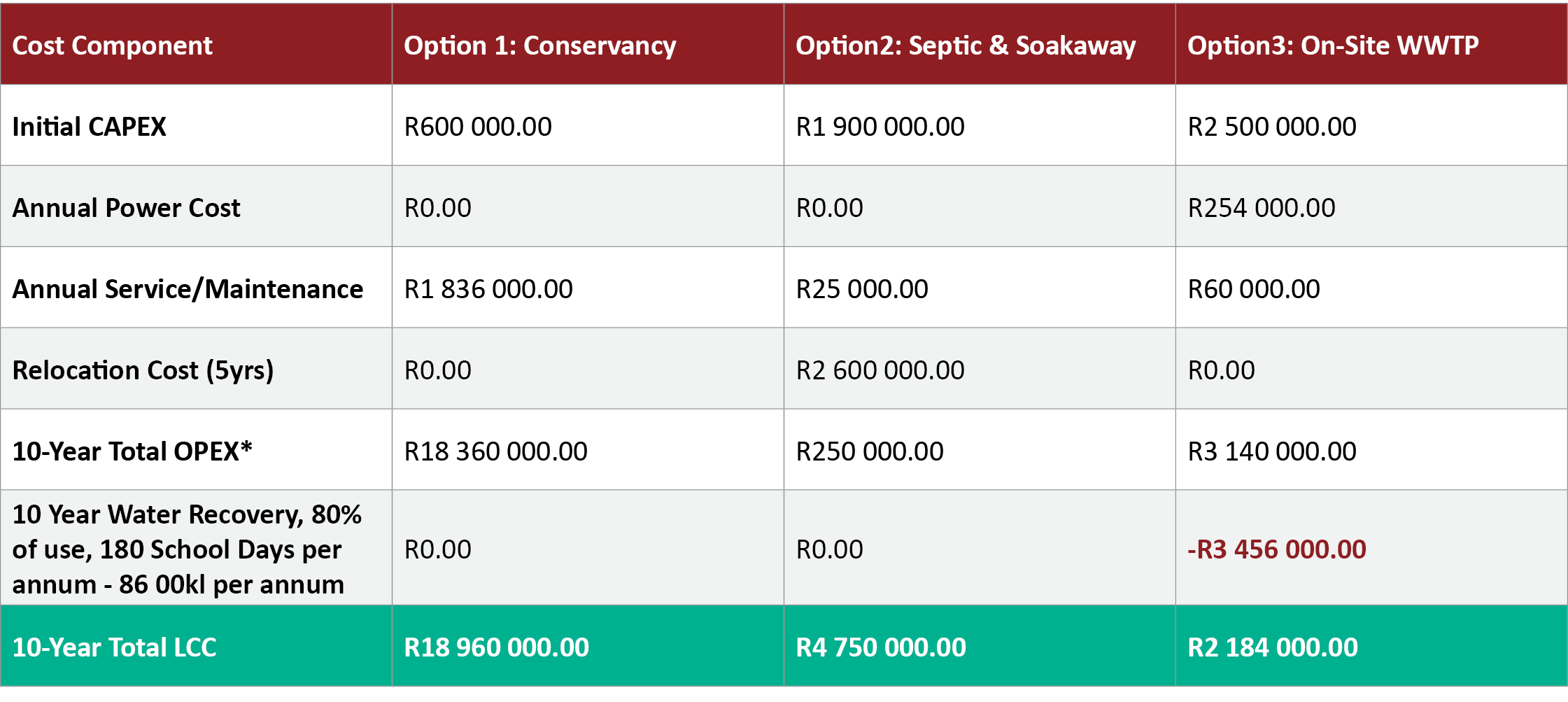
What is clear here is that the conservancy tank is a financial black hole, while the septic tank with a soakaway carries “hidden” debt that emerges when the soil fails.
The on-site wastewater treatment plant has the highest CAPEX but the lowest lifecycle cost. It is the only option that offers true infrastructural sustainability.
Upgrade your school’s system today
Calcamite has installed small-scale wastewater treatment plants at some 38 schools since 2013. Contact us for a feasibility study to upgrade your school’s system.
Read our case studies here: https://calcamite.co.za/blog/